
This page is for informational purposes only. Prolotherapy is currently not part of Dr Samra's preferred scope of practice, and he does not specialise in hypermobility or hypermobile Ehlers-Danlos syndrome (hEDS) specifically.
If prolotherapy is the treatment you are looking for, or you need a clinician with a specific focus on hypermobility, our clinic is unlikely to be the right fit. We would rather tell you now than after you have paid for a consultation. The section on finding a practitioner, further down this page, may help.
Injection treatments explained
Prolotherapy
What it is, what the research does and does not show, and how we approach ligament laxity and hypermobility instead.
What is prolotherapy?
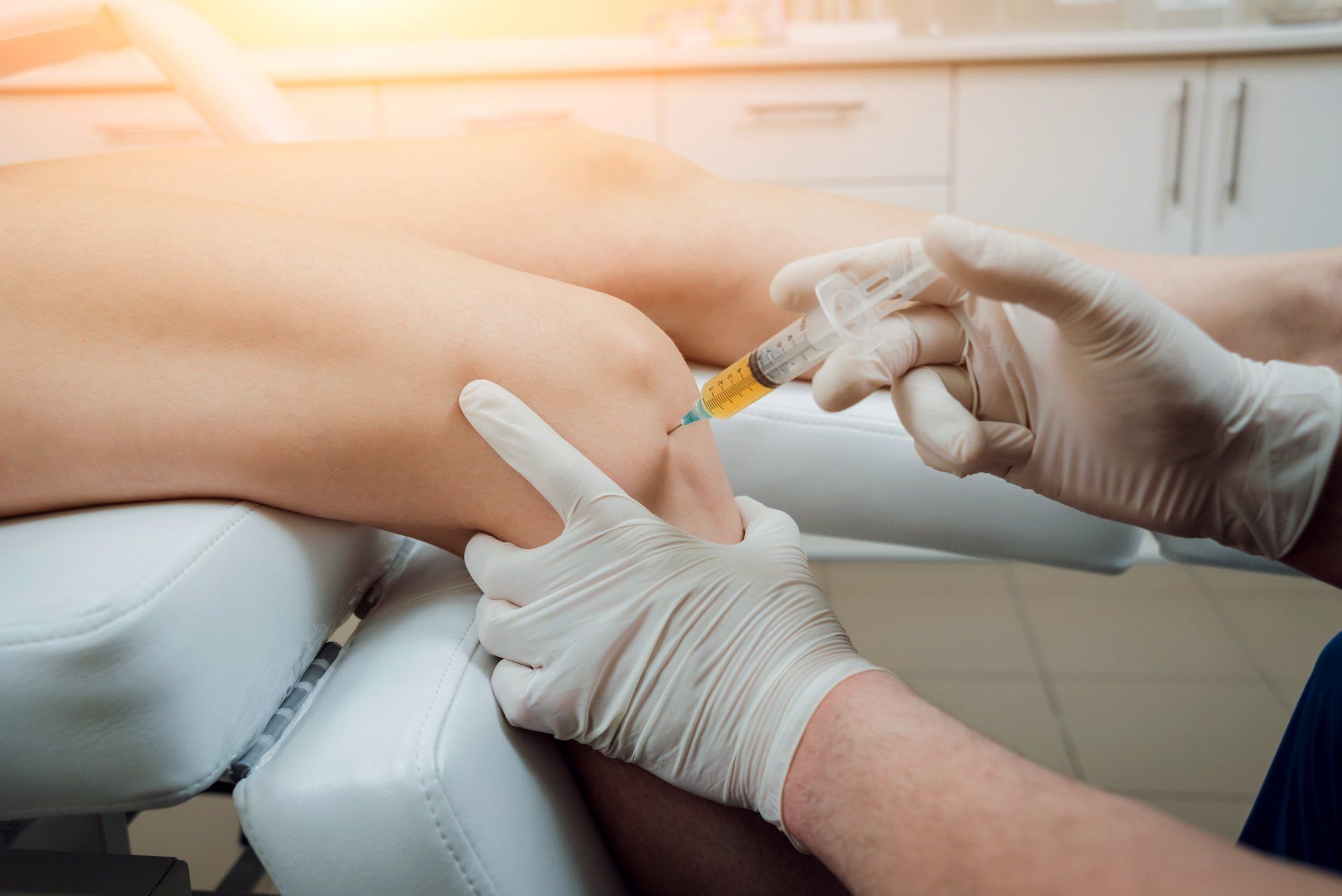
Prolotherapy (short for proliferative therapy) is the injection of a mild irritant solution into or around a ligament, tendon or joint. The most common solution is concentrated dextrose (a form of glucose), usually between 12.5% and 25%, often mixed with a small amount of local anaesthetic. The aim is to provoke a brief, controlled inflammatory response that encourages the tissue to lay down new collagen and, in theory, become stiffer and less painful.
It has been in use since the 1950s and in Australia is mostly performed by doctors trained in musculoskeletal medicine. It is sometimes grouped with PRP under the umbrella of regenerative injection therapies, although the two are different treatments with different evidence bases.
What is it used for?
Practitioners most commonly use prolotherapy for:
- Knee osteoarthritis
- Chronic tendon pain, such as tennis elbow and rotator cuff tendinopathy
- Sacroiliac joint pain and chronic low back pain thought to involve ligament laxity
- Ligament laxity and joint instability, including in people with hypermobility
A typical course involves three to six injection sessions, spaced two to six weeks apart, usually alongside an exercise programme. A post-injection flare of pain for one to three days is common. Serious complications are rare when the procedure is performed with sterile technique, and infection risk is similar to any other injection.
What does the research show?
The honest summary is that the research base is small, the trials are mostly short, and the quality is low to moderate. Prolotherapy has a good safety record, which is not in dispute. Whether it works better than the alternatives, and for whom, is less settled than its advocates suggest and less dismissed than its critics suggest.
Knee osteoarthritis Best studied
A well-designed randomised trial of 90 people found that dextrose injections improved pain and function more than saline injections or home exercise, with the benefit still present at 12 months [1]. Meta-analyses that pool this trial with smaller ones find a consistent benefit over control injections and exercise, but the pooled trial population is only a few hundred people and the reviewers themselves called the evidence preliminary and the studies methodologically limited [2, 3]. The Royal Australian College of General Practitioners' 2018 guideline gives a conditional recommendation against dextrose prolotherapy for knee and hip osteoarthritis, citing low-quality evidence [4]. It is not among the guideline-recommended treatments for osteoarthritis in Australia.
Rotator cuff and tendon pain Conflicting
Trials in rotator cuff tendinopathy go both ways. The best-designed one found that dextrose injected at the tendon attachment outperformed a saline injection under the skin, but performed no better than saline injected at the same tendon attachment, which suggests part of the effect comes from the needle rather than the sugar [5]. A 2025 systematic review of eight studies (431 people) found no significant difference between prolotherapy and control treatments for pain or function [6]. Evidence for tennis elbow comes from small trials and is best described as promising rather than established.
Chronic low back pain Not effective alone
A Cochrane review of five trials (366 people) concluded that prolotherapy injections on their own are no more effective than control injections for chronic low back pain. Two trials that combined prolotherapy with spinal manipulation and exercise reported improvements, but the injections could not be separated from the other treatments [7].
Hypermobility, hEDS and ligament laxity No controlled trials
This is the area most people who contact us about prolotherapy are asking about, and it is the area with the least evidence. There are no published randomised trials of prolotherapy in hypermobility spectrum disorders or hEDS. The published evidence consists of case series; the most recent reported three patients with shoulder instability [8]. A randomised trial of prolotherapy for low back pain in hEDS has been registered in the United States but had not started recruiting at the time of writing [9]. Some people report meaningful relief, and we do not dismiss that. It is not the same as evidence that the treatment works, and it cannot tell us whether it works better than a well-run strengthening programme.
Why the quality matters
Three features of this literature are worth knowing about before weighing any single study. First, the trials are small, which means a positive result is more likely to be chance or bias than it would be in a trial of several hundred people. Second, the protocols vary widely (dextrose concentration, where it is injected, how many sessions, what else is done alongside), so pooling them is of limited value. Third, a substantial share of the research, including some of the systematic reviews, is authored by clinicians who provide prolotherapy, and a good deal of it appears in a journal run by practitioners that is not indexed in the major medical databases. None of that makes the findings wrong, but it does mean the evidence should be read with some care.
How we approach ligament laxity and hypermobility
Dr Samra's practice is built on an exercise-led approach to joint laxity, with injections reserved for specific, identifiable ligament injuries. In practical terms, that means:
- Assessment first. In hypermobility the lax joints and the painful joints are not always the same ones. We examine, review imaging and use ultrasound in the room to work out which structures are driving the problem.
- Strength and neuromuscular control, delivered with our exercise physiologists. A graded strengthening programme is the foundation of every published approach to hypermobility management. We will be honest that the trial evidence for exercise in hypermobility is also thinner than we would like [10], but it carries no procedural risk and it keeps working after the last appointment.
- PRP for a specific injured ligament. Where one ligament has been injured and is healing slowly, such as an ankle syndesmosis or a medial collateral ligament, ultrasound-guided PRP is something Dr Samra offers and has researched. It is a treatment for a particular ligament injury, not for generalised hypermobility.
- Bracing, taping and load management where they help a particular joint through a particular phase.
If that approach is what you are looking for, we would be glad to see you. If you need specialist hypermobility or hEDS care, your GP can refer you to a rheumatologist or a physician with a specific focus in that area, and we are happy to work alongside them on the musculoskeletal side.
Finding a prolotherapy practitioner
We do not want to leave you without a path. Prolotherapy is a core skill of doctors trained in musculoskeletal medicine, and the Australian Association of Musculoskeletal Medicine is their professional body. Their website is the best starting point for finding a practitioner. Your GP may also know of clinicians in your area who offer it. We are not able to make the referral for you or vouch for any particular practice, and we would encourage you to ask any practitioner the same questions about evidence that are set out above.
This page provides general information about prolotherapy and is not a substitute for individual medical advice. It does not describe a service offered at this practice. Progressive Sports Medicine, 121 Norton Street, Leichhardt NSW 2040. Last reviewed October 2026.
References
- Rabago D, Patterson JJ, Mundt M, Kijowski R, Grettie J, Segal NA, Zgierska A. Dextrose prolotherapy for knee osteoarthritis: a randomized controlled trial. Annals of Family Medicine. 2013;11(3):229-237. https://doi.org/10.1370/afm.1504
- Sit RWS, Chung VCH, Reeves KD, Rabago D, Chan KKW, Chan DCC, Wu X, Ho RST, Wong SYS. Hypertonic dextrose injections (prolotherapy) in the treatment of symptomatic knee osteoarthritis: a systematic review and meta-analysis. Scientific Reports. 2016;6:25247. https://doi.org/10.1038/srep25247
- Krstičević M, Jerić M, Došenović S, Jeličić Kadić A, Puljak L. Proliferative injection therapy for osteoarthritis: a systematic review. International Orthopaedics. 2017;41(4):671-679. https://doi.org/10.1007/s00264-017-3422-5
- Royal Australian College of General Practitioners. Guideline for the management of knee and hip osteoarthritis, 2nd edition. East Melbourne: RACGP; 2018. Intra-articular injections: dextrose prolotherapy, conditional recommendation against. racgp.org.au
- Bertrand H, Reeves KD, Bennett CJ, Bicknell S, Cheng AL. Dextrose prolotherapy versus control injections in painful rotator cuff tendinopathy. Archives of Physical Medicine and Rehabilitation. 2016;97(1):17-25. https://doi.org/10.1016/j.apmr.2015.08.412
- Thamrongskulsiri N, Vitoonpong T, Itthipanichpong T, Limskul D, Tanpowpong T, Kuptniratsaikul S. Prolotherapy is not superior to control or placebo-based conservative treatments for rotator cuff tendinopathy: a systematic review and meta-analysis. Clinics in Shoulder and Elbow. 2025;28(4):446-456. https://doi.org/10.5397/cise.2025.00570
- Dagenais S, Yelland MJ, Del Mar C, Schoene ML. Prolotherapy injections for chronic low-back pain. Cochrane Database of Systematic Reviews. 2007;(2):CD004059. https://doi.org/10.1002/14651858.CD004059.pub3
- Michalak N, Banks D, Kane L, Siefferman J. Dextrose prolotherapy for the treatment of chronic shoulder pain in patients with joint hypermobility: a case series. Clinical Medicine Insights: Arthritis and Musculoskeletal Disorders. 2024;17. https://doi.org/10.1177/11795441241264821
- Tulane University. The use of ultrasound-guided dextrose prolotherapy in low back pain in patients with hypermobile-type Ehlers-Danlos syndrome. ClinicalTrials.gov identifier NCT05279937. clinicaltrials.gov/NCT05279937
- Palmer S, Bailey S, Barker L, Barney L, Elliott A. The effectiveness of therapeutic exercise for joint hypermobility syndrome: a systematic review. Physiotherapy. 2014;100(3):220-227. https://doi.org/10.1016/j.physio.2013.09.002